When a business owner starts noticing that output is down, attendance is inconsistent, or people are complaining about fatigue and headaches, the first instinct is usually to look at management, processes, or team motivation. The building rarely comes up as a suspect.
But research on thermal comfort and indoor air quality is fairly consistent: when people are too hot, too cold, or breathing stale recycled air, their cognitive performance drops measurably. Response times slow. Error rates go up. People step out more often or simply disconnect mentally from what they are doing.
In Indian commercial and industrial settings, where summers regularly push ambient temperatures past 42 degrees Celsius and humidity spikes in coastal regions, the building’s HVAC system is not a comfort amenity. It is a productivity infrastructure.
The Signs That Your HVAC System Is the Problem
Most HVAC problems do not announce themselves as equipment failures. They show up as something else entirely:
Any one of these is a signal worth taking seriously. All of them together point to a system that is working harder than it should be for results that are worse than they should be.
What Is Actually Happening Inside an Aging HVAC System
HVAC systems degrade gradually, and the degradation is rarely dramatic enough to trigger an alarm. Filters accumulate dust and restrict airflow. Refrigerant levels drop slightly, forcing the compressor to work harder. Ductwork develops small leaks that bleed conditioned air into false ceilings instead of the occupied space. Heat exchanger coils build up a thin film of grime that reduces their ability to transfer heat efficiently.
The result is a system drawing significantly more electricity while delivering noticeably less cooling. A unit running at 70 percent of its rated efficiency is burning 30 percent more power to produce the same result. For a large commercial facility with dozens of air handling units, that gap translates to lakhs of rupees a year in unnecessary electricity costs.
The Temperature Numbers That Matter
The Bureau of Energy Efficiency in India recommends a thermostat setpoint of 24 degrees Celsius for air-conditioned commercial spaces. Most offices in India run their systems at 18 to 20 degrees Celsius, which requires significantly more energy and creates a thermal shock gap between outdoor and indoor temperatures that is itself a source of discomfort.
Raising the setpoint from 18 to 24 degrees Celsius alone can reduce air conditioning electricity consumption by approximately 6 percent per degree. On a system consuming 50,000 units per month, that is a meaningful number before any equipment change is made.
When Servicing Is Not Enough
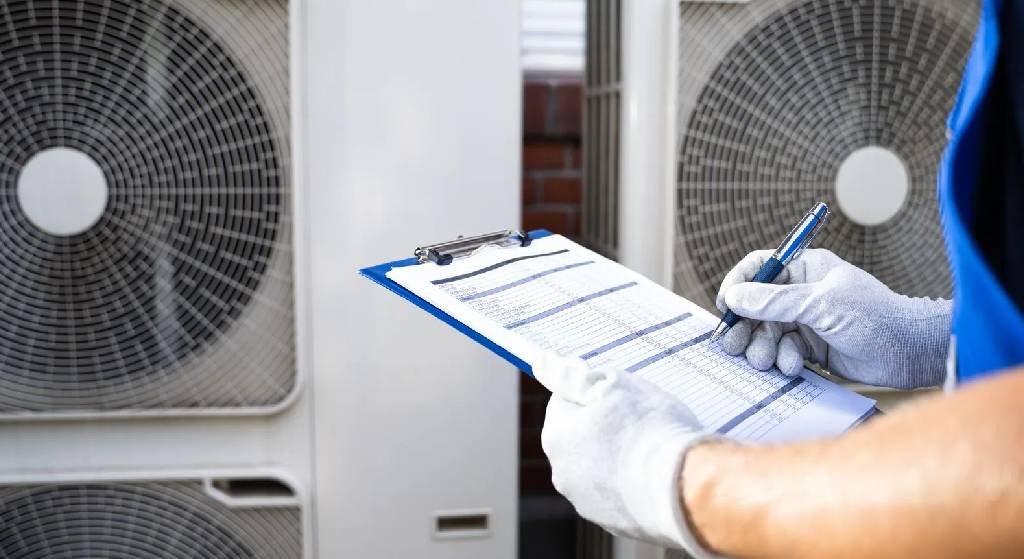
For some facilities, regular maintenance resolves most of the performance gap. Coil cleaning, filter replacement, and refrigerant top-ups restore efficiency close to original levels. For others, the equipment is simply past the point where servicing can make a meaningful difference.
Swawlambi’s HVAC team begins with an assessment of what the existing system is actually delivering versus what the space needs. If targeted maintenance and controls improvements can close the gap, that is the recommendation. If the system is genuinely past its useful life or fundamentally unsuited to the current load, replacement options are presented with full cost-benefit analysis so the decision is based on facts rather than a sales pitch.
Beyond Cooling: Air Quality and Ventilation
Post-2020, indoor air quality has become a serious consideration in commercial building management. Poorly ventilated spaces with high occupancy accumulate carbon dioxide and airborne particulates at levels that impair cognitive function and raise illness-related absenteeism. Fresh air intake rates, filtration standards, and exhaust air management are all part of what a properly designed HVAC system should address.
If your building’s ventilation was designed for a different occupancy level or a different era, it is worth reviewing whether the current setup is serving the people inside it.