Most commercial HVAC problems do not happen suddenly. They build up over weeks and months, quietly reducing efficiency and increasing electricity consumption, until something finally breaks at the worst possible time. The good news is that most of these failures are entirely preventable with a structured maintenance routine.
This checklist is built around the realities of Indian commercial buildings: high ambient temperatures, dusty environments, humidity variation across regions, and HVAC systems that often carry heavier loads than their original design assumed. Use it as a working schedule for your facility management team or share it with your AMC provider to hold them accountable.
Monthly Maintenance Tasks
1. Clean or replace air filters
Clogged filters are the single most common cause of reduced HVAC efficiency. In dusty Indian environments, filters accumulate debris faster than manufacturer schedules suggest. Check filters monthly and clean or replace them whenever airflow feels restricted. A blocked filter forces the blower motor to work harder, consuming more electricity for less airflow.
2. Check thermostat calibration and setpoints
Verify that thermostat readings match actual room temperature using a separate thermometer. Miscalibrated thermostats cause systems to run longer or shorter than needed. Also confirm that setpoints are set to the BEE-recommended 24 degrees Celsius rather than the 18 to 20 degrees Celsius that many offices default to, which costs significantly more to maintain.
3. Inspect drain pans and condensate lines
Blocked condensate drain lines cause water overflow, damage ceilings, and create conditions for mould growth inside air handling units. Check that drain pans are clear and water is flowing freely through the condensate pipe. In humid climates this is especially important during the monsoon season.
4. Listen and look for anything unusual
Walk through the facility and note any unusual sounds from indoor units or outdoor condensers. Rattling, grinding, or squealing sounds are early warnings of mechanical problems that are far cheaper to fix at this stage than after a breakdown. Also look for ice formation on refrigerant lines, which indicates airflow restriction or refrigerant issues.
Quarterly Maintenance Tasks
1. Clean evaporator and condenser coils
Dust and grime accumulate on coil surfaces and act as an insulating layer, reducing the coil’s ability to transfer heat. A thin film of grime on a condenser coil can reduce system efficiency by 15 to 20 percent. Coil cleaning requires proper chemical solutions and should be done by a qualified technician, but it should be on your calendar every three months in high-dust environments.
2. Check refrigerant levels
Low refrigerant forces the compressor to work harder and run longer to achieve the same cooling. It is also a sign of a leak somewhere in the system. Refrigerant checks and top-ups should only be performed by a certified technician, but the point is to schedule them rather than wait for the system to start underperforming visibly.
3. Inspect electrical connections and controls
Loose electrical connections at contactors, capacitors, and control boards are a common failure point and a safety hazard. A technician should check terminal tightness, measure capacitor health, and verify that safety controls like high-pressure cutouts and thermal overloads are functioning correctly.
4. Check fan belts and bearings
For older air handling units with belt-driven blowers, belt tension and condition should be checked quarterly. A worn belt reduces airflow and can snap unexpectedly. Bearing lubrication should also be checked to prevent overheating and motor failure.
1. Full system performance test
Once a year, have your HVAC contractor measure actual system performance against rated capacity. This means measuring supply air temperature, return air temperature, airflow volumes, and compressor operating pressures. A system that was delivering 90 percent of rated capacity three years ago may now be at 70 percent, with correspondingly higher electricity consumption per unit of cooling delivered.
2. Ductwork inspection for leaks and insulation condition
Duct leaks in false ceilings are one of the most overlooked sources of HVAC inefficiency. Conditioned air bleeding into unconditioned ceiling voids means your system has to work harder to maintain space temperature. Annual ductwork inspection, particularly at joints and bends, can identify leaks before they become significant losses.
3. Review zoning and occupancy patterns
Over time, office layouts change, new equipment is added, and occupancy patterns shift. An HVAC zone that made sense three years ago may now be overcooling an empty storage area while undercooling a densely occupied workspace. Annual review of zoning and thermostat schedules ensures the system is actually serving the spaces that need it.
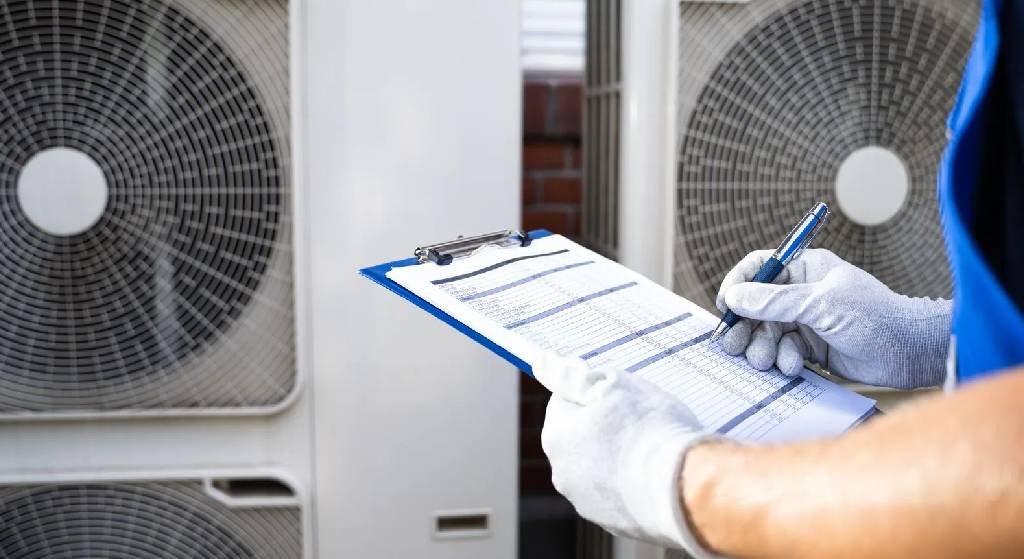
If your building does not have an Annual Maintenance Contract with a qualified HVAC service provider, this checklist is also a brief for why you need one. The tasks above require a combination of in-house facility management attention (filters, drain pans, thermostat checks) and certified technician visits (coils, refrigerant, electrical, performance testing).
Swawlambi offers AMC services for commercial HVAC systems that cover all of the above, with scheduled visits, documented service records, and priority response for breakdowns. A well-structured AMC typically saves more in prevented breakdowns and reduced electricity consumption than it costs within the first year.